Blog/How to be comfortable talking on camera
5 steps to get comfortable talking on camera (2026)
Key takeaways
- Talk to a person, and let your phone record from the side.
- Say your best lines out loud a few times before you record.
- Sit down once. One good talk can become posts, emails and short videos.
To get comfortable talking on camera, talk to a person instead of the lens. This is my 5-step method, the one I use myself and with my clients. It's for business owners and experts who are fine one to one and freeze the second they hit record. You say your ideas out loud with someone first. Then you set your phone on the side and keep talking.
Why do I freeze on camera when I'm fine one to one?
Across a table, you get a face back. On camera, you get silence and your own reflection.
You can see a client nod. You can see the moment they get it. You get nothing back from a lens.
My team listens to what business owners say in online forums. In one batch, we heard the same thing 12 separate times: fine one to one, frozen in front of a room or a camera. One owner put it this way:
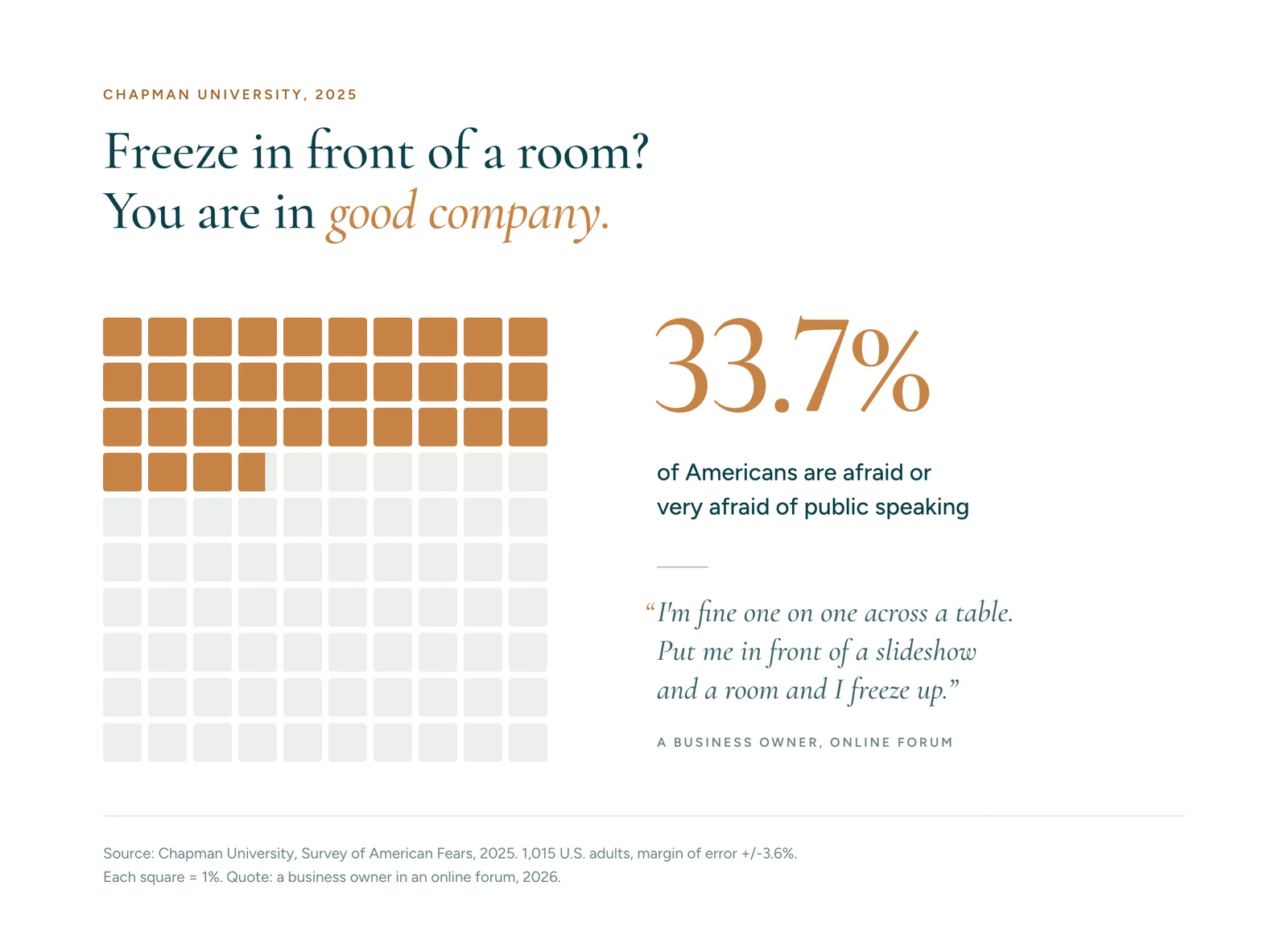
"I'm fine one on one across a table. Put me in front of a slideshow and a room and I freeze up."
He had a shot at a client that could roughly double his accounts. He'd earned the meeting with his work. Now he had to perform.
Researchers have looked at something close to this. A Stanford team surveyed 9,787 people about video calls in early 2021. People who reported more "mirror anxiety," the stress of watching your own face on screen, also reported feeling more worn out. That study was about video calls, and the researchers found the two went together. They didn't prove one caused the other. But I see the same thing every week. People get stiff when they're watching themselves talk.
You're in good company, too. In Chapman University's 2025 Survey of American Fears, 33.7% of Americans said they were afraid or very afraid of public speaking.
If you've ever propped your phone up, said "Hi, I'm..." three times, and put it back in your bag, this post is for you.
My take: why is most camera advice backwards?
Most people who give camera advice treat it like a solo show. Fix your lighting. Breathe. Rehearse in a mirror. Look straight into the lens.
I think that's backwards.
When you practice in a mirror, you spend even more time watching your own face. When you stare into the lens, you're talking to a little black circle that never nods back. And you didn't get good at your work by performing alone. You got good by talking to people, one client at a time.
So I start somewhere else. I start with a person. You say it out loud before you ever record it, and the phone goes on the side, where you can forget it's there.
That's my opinion. I didn't test it in a lab. I built it from how I work with people every week.
My 5-step method for getting comfortable talking on camera
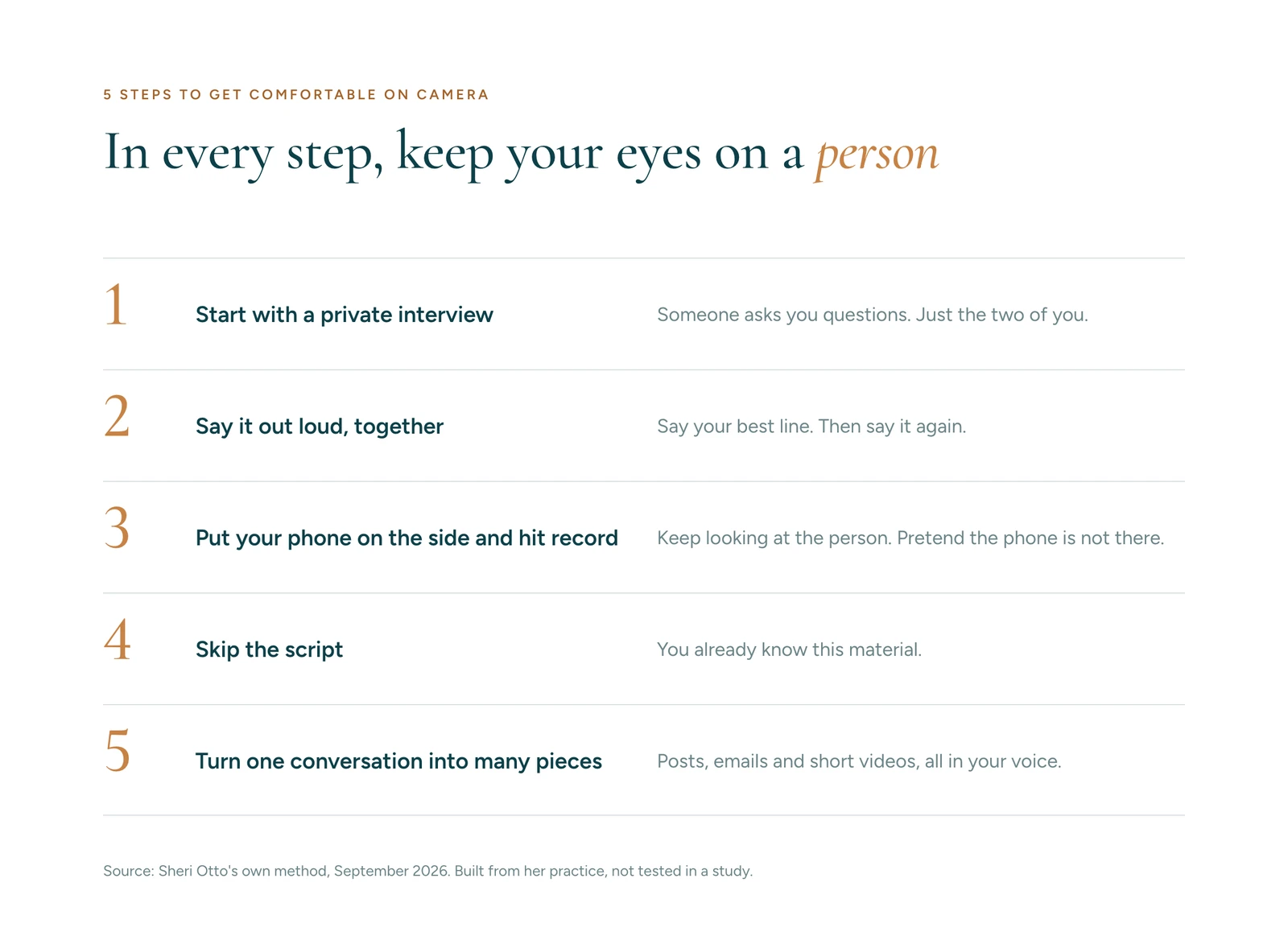
In every step, you keep your eyes on a person.
-
Start with a private interview. Before anything goes online, someone asks you questions. Just the two of you. I ask things like "What do you wish more people knew?" and "What's the best kept secret we haven't talked about? Why is it important? And who needs to hear it the most?" Then I go deeper: what kind of impact could you have if more people thought a little more like you? This is where we find your juice. I extract and shape your messages from your own way of seeing things, your experience and what you know.
-
Say it out loud, together. Once we find a line worth keeping, you say it. Then you say it again. In my words: "hearing themselves say it just helps them refine how it should be said, but then also relieve some of the pressure." After a few rounds, people "begin to just talk through it very freely."
-
Put your phone on the side and hit record. I ask people to "put their phone up on the side and just hit record while we still talk." You keep looking at me, and "sometimes just pretend like the phone is not there." You never have to watch your own face while you talk. We ease into sharing online without the pressure of being perfect on camera.
-
Skip the script. You already know this material. When I roll on a content day, it's phone on the side, no script. In online forums, one person put it like this: "I just wanna learn how to speak to camera without a script. Right now I am struggling to speak even with a script." You don't need a better script. You need to have said your own lines out loud, to a person, a few times.
-
Turn one conversation into many pieces. You don't have to do this every day. I tell people one good talk "can turn into text-based content, video content. It can turn into posts, emails, and it can become future talks and speeches." So you sit down once, and I turn that one conversation into posts, emails and short videos, all in your voice. When one of those pieces is an email, you can check it for free at FixMyEmail.ai. Paste it in and see what to change, and why.
Why does being seen matter this much to me?
In April 2026, I left my corporate job. The timing wasn't mine. The decision was. I chose not to go back to corporate.
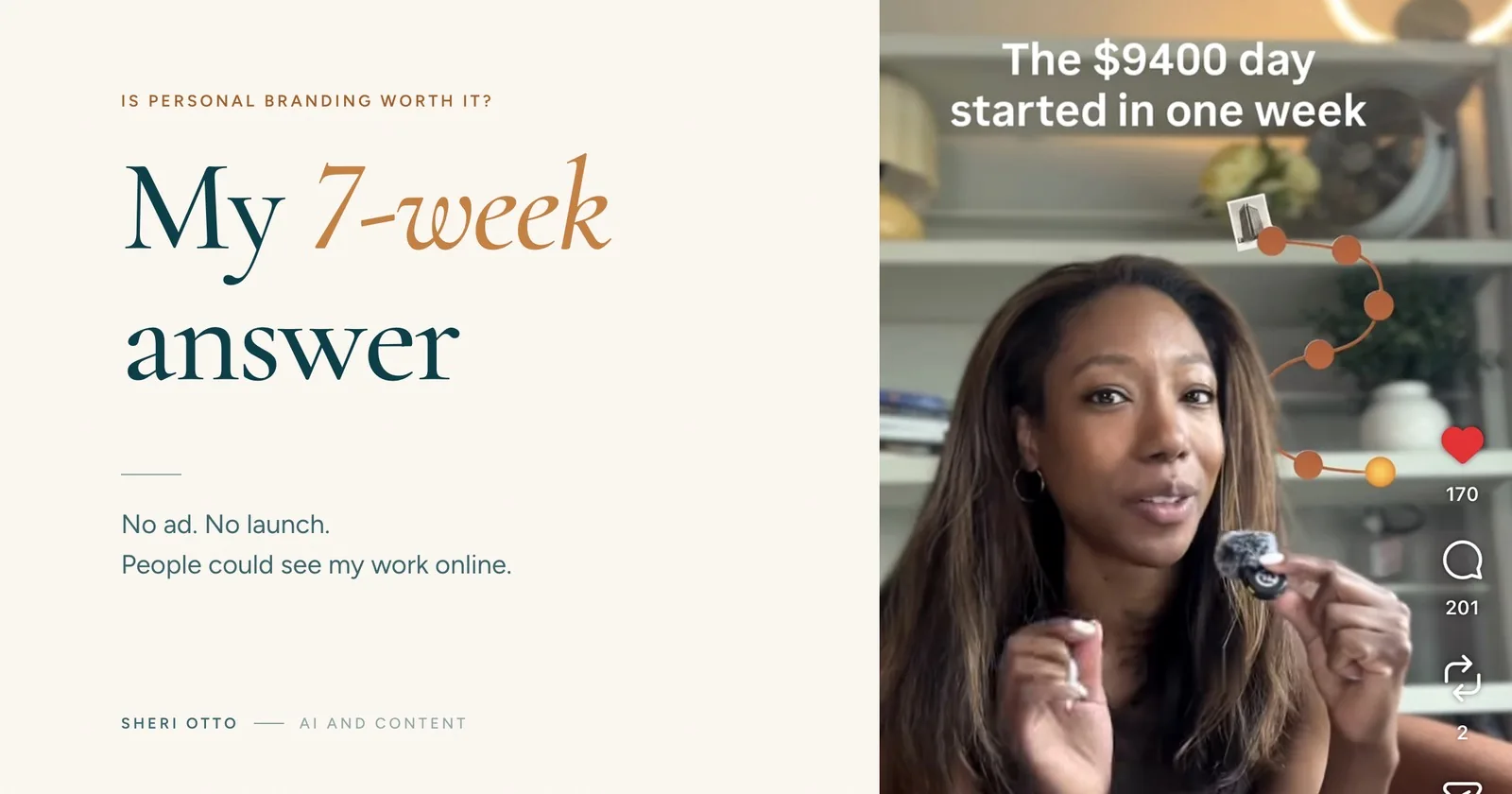
Within seven weeks, I had earned more than my six-figure corporate salary. Not because of an ad or a launch. Because people could see my work online.
I see content as a vehicle for options. Most people who are great at what they do never get to use it.
That's why I push on the camera part. If people can't see your work, they can't ask for you. And when the right people see you more often, they start asking for you.
I post every day now.
When I started, I was nervous. My kids were small, and I was scared they'd interrupt a video. Back then, that felt like the worst thing in the world. I spent a lot of energy putting on a polished front. Now I show up as I am. It takes the least energy, and it's my best bet.
How long does it take to get comfortable on camera?
I can't give you a number of days, and I won't make one up. For me, it took over a year of showing up consistently. It still isn't 100% easy. But what people need to hear from me now outweighs how I feel in the moment.
I can tell you where it starts. You start the first time you say your best line out loud to a person, before you ever record it. You don't wait until you feel ready. You start talking, and you let the phone roll on the side.
What this can and can't show
- The 12 mentions. My team counted them in one batch of online forum posts, September 2026. You can see how owners describe the problem. You can't tell how many owners feel it.
- The Stanford study. The 9,787 people chose to join an online survey about video calls, February to March 2021. The researchers didn't test whether looking away from the lens makes anyone better on camera.
- The Chapman survey. Chapman University surveyed 1,015 American adults in a nationally representative sample in 2025. The margin of error is plus or minus 3.6%.
- The five steps. I built them from my own practice. Nobody has tested them in a study, so I can't promise you a timeline.
FAQ
Why do I feel awkward on camera?
Most people feel awkward because they're watching themselves instead of talking to someone. Across a table, you get a nod or a question back. When you talk to a person and let the phone record from the side, you stop watching yourself.
How do I sound natural on camera?
Say your ideas out loud to a person a few times before you record. Then keep talking to that person while the phone rolls. You sound like you because you're talking the way you talk to clients.
Should I use a script on camera?
Skip the script if you know your subject. Business owners and experts explain their work every day. Practice your best lines out loud with someone, then talk freely, with nothing to memorize.
How do I get better at talking on camera?
Record conversations instead of speeches. That's the heart of Sheri Otto's 5-step method: have someone interview you, set your phone on the side, and hit record. Then turn that one talk into posts, emails and videos.
How can I be confident on camera?
Most people feel confident on camera once they're clear on what they know. When you've said your best ideas out loud a few times, with a person listening, you stop searching for words.
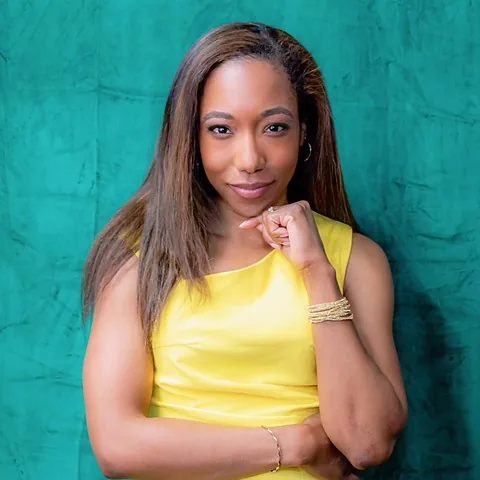
About Sheri Otto
Sheri Otto has spent 15 years in growth marketing, including her time at HubSpot. She co-hosted HubSpot's first INBOUND webinar and is a HubSpot UNBOUND26 Insider. More about Sheri →
Sources
- Chapman University, Survey of American Fears, Wave 11, Key Findings (2025). 1,015 respondents, nationally representative, fielded by SSRS, margin of error +/-3.6%. https://www.chapman.edu/wilkinson/research-centers/babbie-center/_files/2025/Key-Findings-Survey-of-America-Fears-2025.pdf (accessed September 30, 2026)
- Fauville, Luo, Queiroz, Lee, Bailenson and Hancock, "Video-conferencing usage dynamics and nonverbal mechanisms exacerbate Zoom Fatigue, particularly for women," Computers in Human Behavior Reports (2023). 9,787 participants, data collected February to March 2021. https://doi.org/10.1016/j.chbr.2023.100271 (accessed September 30, 2026)
- Growth Lane Strategies listening research, online business-owner forums, batch of September 21, 2026 ("fine one to one, frozen in front of a room or a camera," 12 mentions). Forum quotes from August 18, 2026 and September 12, 2026.
- Sheri Otto's own method and story, in her words (September 2026). About Sheri
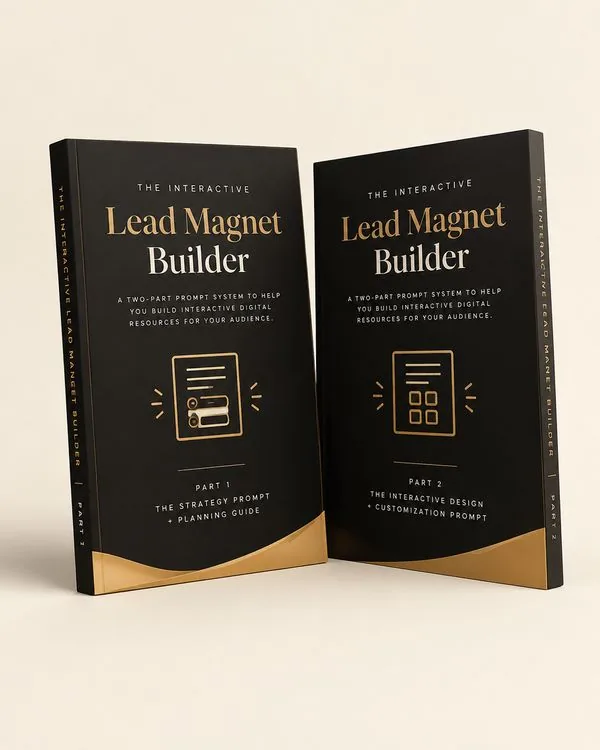
Free tool
Interactive Lead Magnet Builder
A mega prompt system that turns what you already know into an interactive lead magnet: a scorecard, a checklist or a step-by-step guide that people want to use.
Send me the builder →